
Advantages of Garnet Waterjet sand in Waterjet Cutting
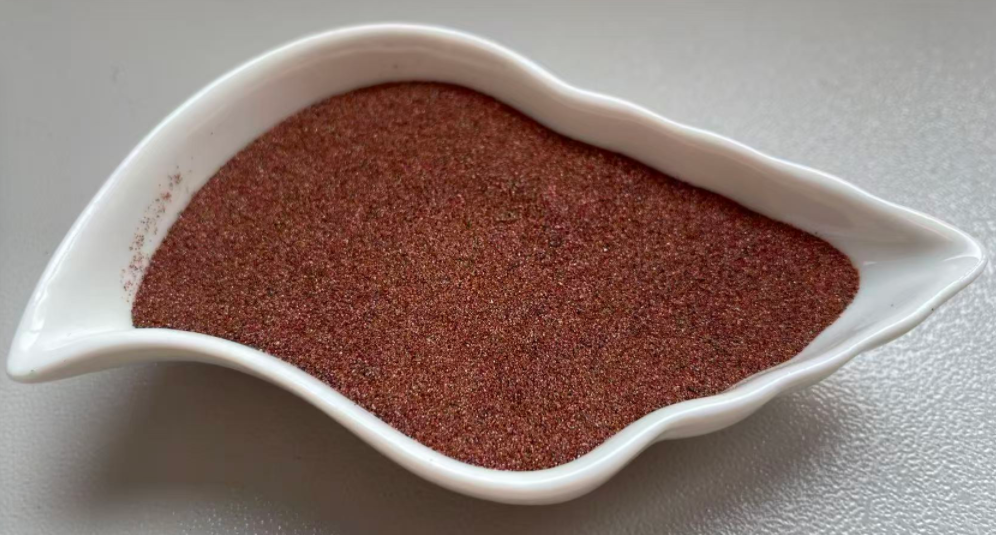
Garnet (almandine garnet) is currently the mainstream abrasive used in waterjet cutting worldwide. Compared with silica sand, alumina, silicon carbide, and glass sand, it performs best in five aspects: cutting performance, equipment wear, finished product quality, cost, and environmental friendliness. These advantages are mainly reflected in the following:
I. Physical and mineral properties: Perfect balance between cutting force and toughness
1. Moderate hardness (Mohs 7.5–8), balancing cutting speed and nozzle life. Its hardness is higher than glass abrasive and olivine, significantly improving cutting efficiency; yet it is far lower than alumina and silicon carbide. Excessively hard abrasives will rapidly wear down the focusing tube and sapphire nozzle, while garnet can increase the abrasive tube’s lifespan by 70%–90%, greatly reducing downtime costs associated with parts replacement.
2. High density (3.8–4.2 g/cm³), sufficient kinetic energy. Under the same water pressure, the particles carry a stronger impact force, which can easily cut stainless steel, titanium alloy, granite, thick glass, and composite materials, with a maximum cutting thickness of up to 300 mm; low-density abrasives have weak cutting power and extremely low efficiency in processing thick plates.
3. Semi-angular particles with moderate toughness, maintaining sharpness: Naturally semi-angular in shape, they continuously generate new cutting edges after high-pressure impact and fragmentation, maintaining stable cutting ability throughout the process.
4. Pure particle size and minimal dust, preventing sand blockage. Industrial-grade garnet has a purity of 95%–98% after purification, with minimal ultrafine dust and large particles, making it less likely to clog sand valves and mixing chambers. This ensures continuous and stable equipment production and reduces downtime due to cleaning and blockages.
II. Finished product quality: high precision, minimal chipping, and smooth surface.
1. The cut is smooth with shallow ripples and low roughness. The particles are cut with uniform force, and the cut surface has fine striations. No secondary grinding is required for stainless steel, aluminum plates, and stone cuts. When cutting brittle materials such as glass and ceramics, it is not easy to have chipped edges, cracks, or micro-cracks. It is suitable for precision sheet metal, decorative stone, and optical glass processing.
2. Cold cutting without thermal deformation or oxide layer: Waterjet cutting with garnet abrasive is a pure cold process that does not generate a heat-affected zone. Titanium alloys, aluminum alloys, and composite materials will not be ablated, hardened, or warped, making it suitable for high-precision parts in aerospace and new energy industries.
3. No surface embedding contamination: With moderate hardness, very few particles embed into the workpiece surface after cutting; hard particles such as alumina and corundum are easy to get stuck in metal gaps, which will cause defects in subsequent welding, spraying and electroplating.
Ⅲ, low equipment wear and tear significantly reduces costs.
1. The lifespan of the focusing tube (sand tube) is greatly extended. Silicon carbide and corundum abrasives will wear through the sand tube quickly, while garnet can extend the sand tube replacement cycle by several times, reducing the frequency of purchasing spare parts and downtime, and reducing the overall operation and maintenance cost of the factory by 40%-50%.
2. Minimal wear on sand supply lines and valves. Less dust and more uniform crushing prevent serious erosion of sand supply lines and valves, resulting in lower failure rates for water pumps and cutting heads.
3. Optimal overall material cost: Garnet has a very low unit price; sand consumption is even lower and parts wear is less. The long-term total cost of mass production is far lower than that of hard synthetic abrasives, making it the first choice for mass production in hardware, stone and sheet metal factories.
IV. Environmentally friendly and safe, with strong compliance.
1. Free of free silica, eliminating the risk of silicosis. Traditional quartz sand contains free silica, and dust can cause irreversible pneumoconiosis; garnet contains no free silica, and the dust hazard in the workshop is extremely low, which meets occupational health standards.
2. Non-toxic, non-radioactive, and chemically inert natural minerals, it does not leach heavy metals or harmful substances and can be used for cutting food equipment and medical stainless steel parts; the waste is non-toxic and pollution-free, and the wastewater can be recycled simply by sedimentation.
3. Recyclable and easy to treat solid waste: In a closed-loop water circulation system, the material can be reused 2-3 times after screening; waste garnet has no hazardous waste properties and can be directly recycled as asphalt and concrete filler, resulting in extremely low solid waste disposal costs; synthetic abrasives are mostly industrial hazardous waste with high treatment costs.
4. The dust emission is much lower than that of silica sand and slag. The particles have a high specific gravity, resulting in less fine powder after crushing and cleaner air in the workshop.
V. Extremely versatile, compatible with almost all cutting materials
It can process all types of industrial materials without the need for frequent abrasive changes.
Metals: Carbon steel, stainless steel, aluminum, copper, titanium, cemented carbide
Stones: marble, granite, slab, ceramic tile
Brittle materials: float glass, tempered glass, ceramics, sapphire
Composite materials: carbon fiber, fiberglass, rubber interlayer, fireproof board. Soft abrasives cannot cut thick metals, and superhard abrasives are only suitable for a small number of superhard special materials. Their versatility is far inferior to that of garnet.
