
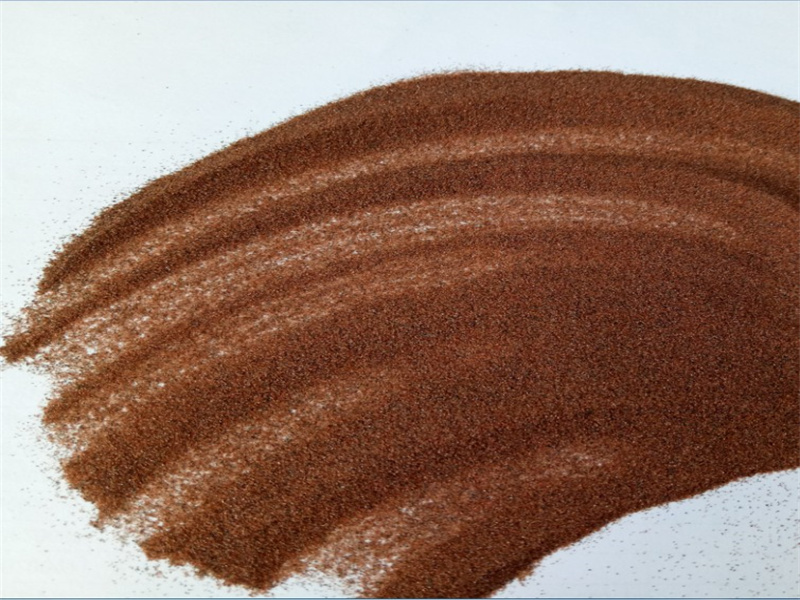
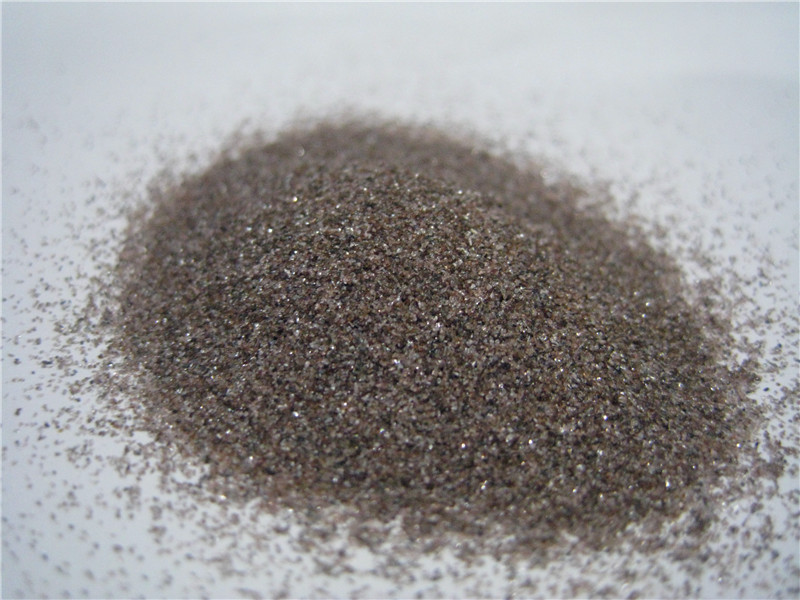
Advantages of garnet waterjet sand compared to brown fused alumina
Brown fused alumina has a Mohs hardness of 9.0. While hard, it is brittle and has sharp edges, causing severe wear on waterjet lines and nozzles. Garnet, on the other hand, has a Mohs hardness of 7.5-8.5, making it suitable for waterjet cutting. It balances cutting force, consumable life, machining accuracy, environmental friendliness, and operational stability, making it the mainstream abrasive for high-precision waterjet cutting. Its advantages are detailed below:
I. Lower Equipment Wear and Significantly Extended Service Life of Nozzles and Pipelines
1. Optimal Hardness Compatibility: Garnet has moderate hardness, unlike brown fused alumina which is too hard and will cause rapid wear and tear on waterjet nozzles, mixing pipes, and abrasive valves during high-speed erosion.
2. More Friendly Particle Shape: High-quality waterjet garnet consists of sub-angular, rounded particles, while brown fused alumina is a sharp, multi-pointed crystal. Rounded particles flow smoothly, resulting in less frictional resistance when passing through abrasive pipes and nozzles, and less wear on the pipe walls.
II. Less Dust, More Friendly Production Environment, and Lower Occupational Disease Risk
Brown fused alumina is highly brittle and easily shatters upon high-speed impact, generating a large amount of ultrafine dust and causing severe dust pollution in the workshop. Garnet, on the other hand, has good toughness and strong resistance to breakage; after impact, only the surface cracks, creating new cutting edges, resulting in an extremely low overall dust rate and reducing dust by more than 70% compared to brown fused alumina.
III. Less Prone to Sand Pipe Clogging, Enhanced Continuous Production Stability
1. Garnet undergoes washing, multi-stage magnetic separation, and fine grading, resulting in minimal clay, fine powder, and agglomerated impurities, with strictly controlled particle size ranges. Brown fused alumina, on the other hand, often contains calcined lumps and ultrafine powder, making it highly susceptible to agglomeration and sand pipe clogging when damp.
2. Garnet particles exhibit excellent flowability, ensuring smooth transport over long distances through sand pipes and minimizing the occurrence of sand blockage, cut deviation, and waste plates caused by sand breakage. Brown fused alumina, with its sharp corners easily interlocking, and fine powder filling gaps, leads to poor flowability, frequent gun blockage, and frequent shutdowns for sand cleaning, resulting in reduced production capacity.
IV. Higher surface finish, no need for secondary polishing in precision machining
1. Brown fused alumina has sharp and hard edges, which can easily cause deep scratches, pitting, and chipping at the cut edges of sheet materials during high-speed cutting. Stainless steel, aluminum alloys, sintered stone, and composite materials require polishing after precision machining.
2. Garnet has a milder hardness and uniform particle size, producing fine and regular cutting patterns without large scratches. Titanium alloys, copper, stone, and carbon fiber sheets can be directly cut to meet assembly precision requirements, eliminating the need for polishing and resulting in higher overall processing efficiency.
3. Brown fused alumina is prone to edge chipping when used on soft materials (aluminum, copper, plastics, honeycomb composites), while garnet does not excessively erode the edges of the workpiece.
V. Extremely Stable Chemical Properties, Suitable for Cutting Special Corrosion-Resistant Workpieces
Garnet is chemically inert, resistant to acids and alkalis, and contains no free iron ions and has extremely low chloride ion content; brown fused alumina contains alumina and trace amounts of iron impurities:
1. Cutting stainless steel, titanium alloys, nickel-based alloys, and corrosion-resistant sheets: Iron impurities in brown fused alumina easily remain on the cut surface, causing rust spots on the workpiece later; garnet does not release metal ions, eliminating the risk of rust after cutting, making it suitable for processing chemical and marine corrosion-resistant parts.
2. Can cut glass, ceramics, and acid and alkali-resistant composite materials without causing corrosion of the substrate by abrasive components.
VI. Reusable Abrasive, Lower Cost per Use
Garnet has excellent toughness, resulting in a high percentage of intact particles per cut. After sieving to remove fine powder, it can be recycled 8-15 times; brown fused alumina shatters upon impact, mostly turning into dust after one use, making it virtually impossible to recycle. VII. Wider Range of Compatible Materials, Suitable for Both Hard and Soft Materials
1. Hard Materials (Steel Plates, Sintered Stone, Hard Alloys): Garnet has sufficient cutting force to meet the needs of cutting conventional thick plates;
2. Soft/Brittle Materials (Aluminum Alloys, Copper, Glass, Carbon Fiber, Rubber Sandwich Plates): Brown fused alumina is too hard and easily chipped and scratched. Garnet can cut through while protecting the workpiece’s integrity, making it the only suitable and economical abrasive for composite materials and precision non-ferrous metals; Brown fused alumina is only suitable for rough cutting of thick carbon steel, and its processing of thin and soft materials is extremely limited.
VIII. Easier Waste Disposal, Simpler Environmental Compliance
1. Garnet is non-toxic and contains no free silicon, and is not classified as hazardous waste. Cutting waste can be conventionally landfilled, recycled, purified, and reused as sandblasting filter material;
2. Brown fused alumina contains a lot of fine powder, mixed with alumina dust, making solid waste treatment and control stricter; moreover, brown fused alumina dust is more difficult to settle, and wastewater sedimentation takes longer.
